The historical identity of the Barak Valley, particularly the meanings attached to terms such as “Kachar” and “Kachari,” has often been oversimplified in popular discourse. Drawing on scholarship on pre-colonial eastern and northeastern India, this article argues that these terms were not originally rigid ethnic markers but evolved through geographical, political, and linguistic interactions. The evidence suggests that Barak Valley functioned as a contact zone where Bengali linguistic culture and Tibeto-Burman political formations coexisted, complicating modern identity narratives.
1. Introduction
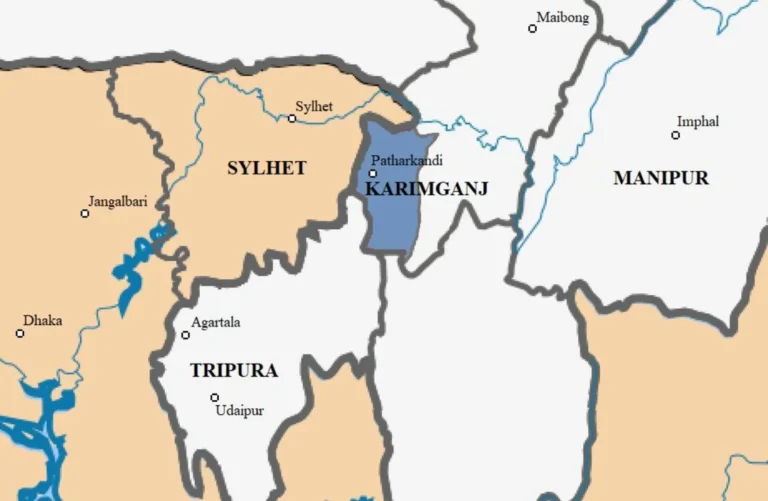
The Barak Valley, historically linked with the Surma Valley and Srihatta, occupies a unique position in the historical geography of eastern South Asia.¹ Modern discussions often attempt to assign singular ethnic or linguistic identities to the region, frequently invoking terms such as “Kachari” in a narrowly defined sense.² However, historical evidence from pre-colonial and early colonial sources reveals a far more layered and fluid reality.
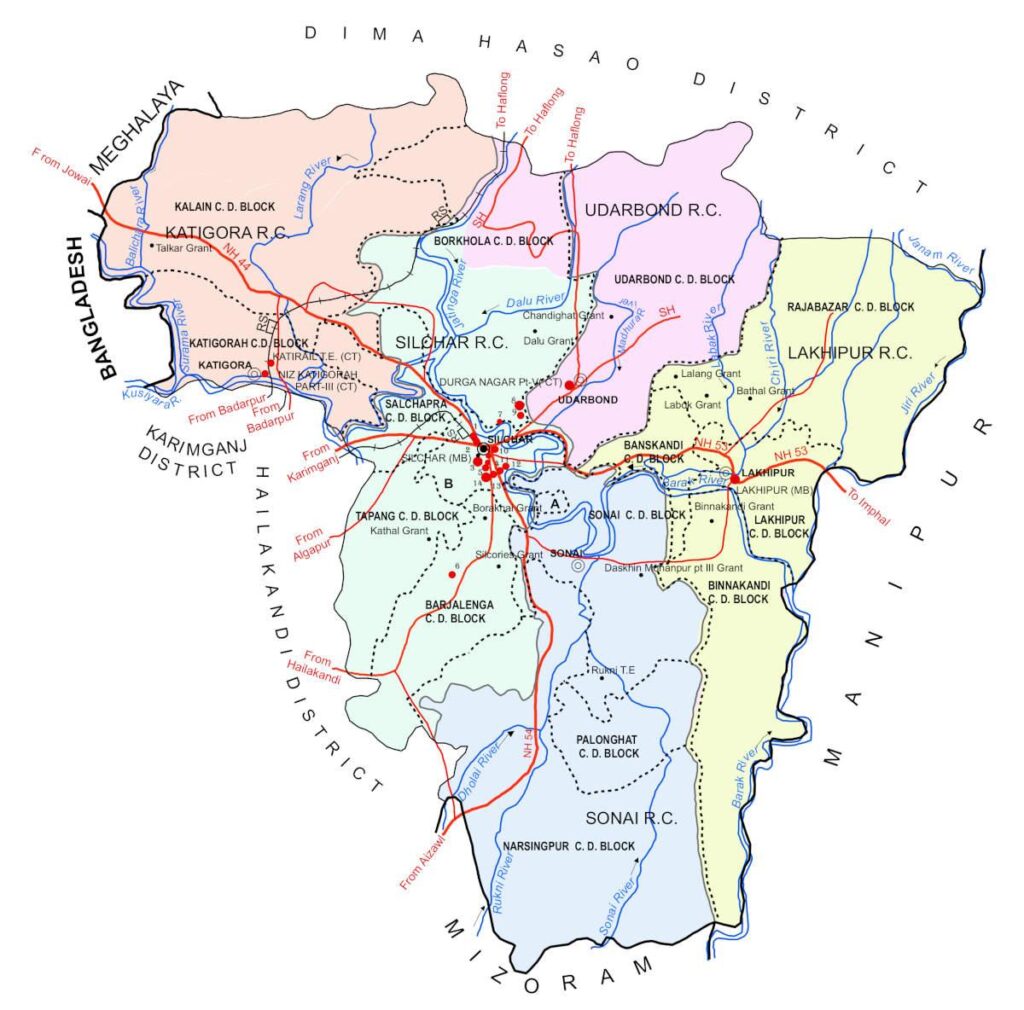
This article reexamines the meanings of “Kachar” and “Kachari” through textual and historical analysis, demonstrating that these categories were shaped by geography, language, and political power rather than fixed ethnic boundaries.
2. The Dimasa Polity and Tibeto-Burman Presence
Pre-colonial political history of the region indicates that the Dimasa, a Tibeto-Burman (Bodo) group, were a significant ruling power in parts of present-day Cachar. They are frequently referred to in colonial and early historical records as “Kacharis,” although they themselves used the term Dimasa.
This association has led to the widespread assumption that “Kachari” is an ethnically defined category tied exclusively to the Dimasa or related Bodo groups. However, such an interpretation does not fully align with historical evidence and risks oversimplifying the region’s complex past.
3. The Problem with “Kachari” as an Ethnic Label
Historical scholarship challenges the assumption that “Kachari” was originally an ethnic identifier. Colonial ethnographers often applied the term broadly to several Bodo-speaking groups, suggesting that it functioned as an exonym rather than a self-designation.
There is little evidence to suggest that Bodo or Dimasa groups were uniformly known as “Kachari” prior to their political prominence in Cachar. Instead, the name appears to have been applied in relation to territory and administrative classification rather than representing an ancient ethnonym.
This distinction is crucial, as it shifts the understanding of “Kachari” from a fixed tribal identity to a fluid, context-dependent designation shaped by political and colonial processes.
4. The Meaning of “Kachar”: A Geographical Term
A key insight lies in the explanation of the term “Kachar.” In Bengali usage, particularly in the Surma Valley, the word refers to low-lying land between rivers and hills or riverbanks.
This interpretation is supported by historian Edward Gait, who suggested that “Cachar” is derived from a Sanskrit root referring to the spreading or widening of land.
Such definitions indicate that “Kachar” originated not as an ethnic or political term but as a geographical descriptor shaped by the physical landscape of the Barak and Surma river systems.
5. Who Were the “Kacharis”? A Broader Usage
Local traditions and literary references suggest that the inhabitants of the Barak Valley were referred to as “Kacharis” by neighboring populations, particularly those in Sylhet. Importantly, this designation was not limited to tribal populations. Indigenous Bengali inhabitants of Cachar were also described as Kacharis, while those in Sylhet were identified separately as Sylhetis.
This dual usage demonstrates that “Kachari” functioned as a regional identifier rather than a strictly ethnic one. It reflected location and context rather than a singular linguistic or tribal identity.
6. A Region of Interaction, Not Isolation
Taken together, these insights point to a broader conclusion about the Barak Valley in the pre-colonial period. Rather than being the exclusive domain of a single ethnic or linguistic group, the region functioned as a zone of interaction.
On one hand, there was a strong presence of Bengali linguistic and cultural practices, as reflected in geographical terminology and regional traditions.¹⁸ On the other, there existed significant Tibeto-Burman political formations, such as the Dimasa kingdom, which exercised authority over parts of the region.
This coexistence suggests a dynamic historical landscape in which identities were negotiated and redefined over time.
7. Implications for Modern Identity Debates
The historical fluidity of terms like “Kachar” and “Kachari” has important implications for contemporary identity debates. Colonial administrative practices played a crucial role in transforming flexible regional identifiers into rigid ethnic categories.
Attempts to retroactively impose fixed ethnic or linguistic identities onto the past risk distorting historical reality. Instead, the evidence encourages a more nuanced understanding of identity as historically contingent and shaped by geography, political power, and cultural interaction.
8. Conclusion
A close reading of historical sources reveals that terms such as “Kachar” and “Kachari” were not originally rigid ethnic markers. “Kachar” functioned as a geographical term rooted in regional linguistic usage, while “Kachari” evolved as a flexible regional designation applied to diverse populations.
The Barak Valley thus emerges not as a space defined by a singular identity, but as a historically layered region shaped by interaction between Indo-Aryan and Tibeto-Burman worlds. Recognizing this complexity challenges essentialist narratives and calls for a more historically grounded interpretation of identity in eastern India.
BIBLIOGRAPHY
Barpujari, B. K., ed. The Comprehensive History of Assam. Guwahati: Publication Board Assam, 1990.
Baruah, S. L. A Comprehensive History of Assam. New Delhi: Munshiram Manoharlal, 1985.
Bhattacharjee, J. B. Cachar under British Rule in North-East India. New Delhi: Radiant, 1977.
Chatterji, S. K. The Origin and Development of the Bengali Language. Calcutta: Calcutta University Press, 1926.
Gait, Edward. A History of Assam. Calcutta: Thacker, Spink & Co., 1906.
Kulke, Hermann. The State in India 1000–1700. Delhi: Oxford University Press, 1995.
Mills, J. P. The Kacharis. London: Macmillan, 1929.
Sinha, Surajit. “Tribal Polities and State Systems in Pre-colonial Eastern and North Eastern India.” In Tribe, Caste and Religion in India, edited by R. K. Jain, 23–52. New Delhi: Manohar, 1996.